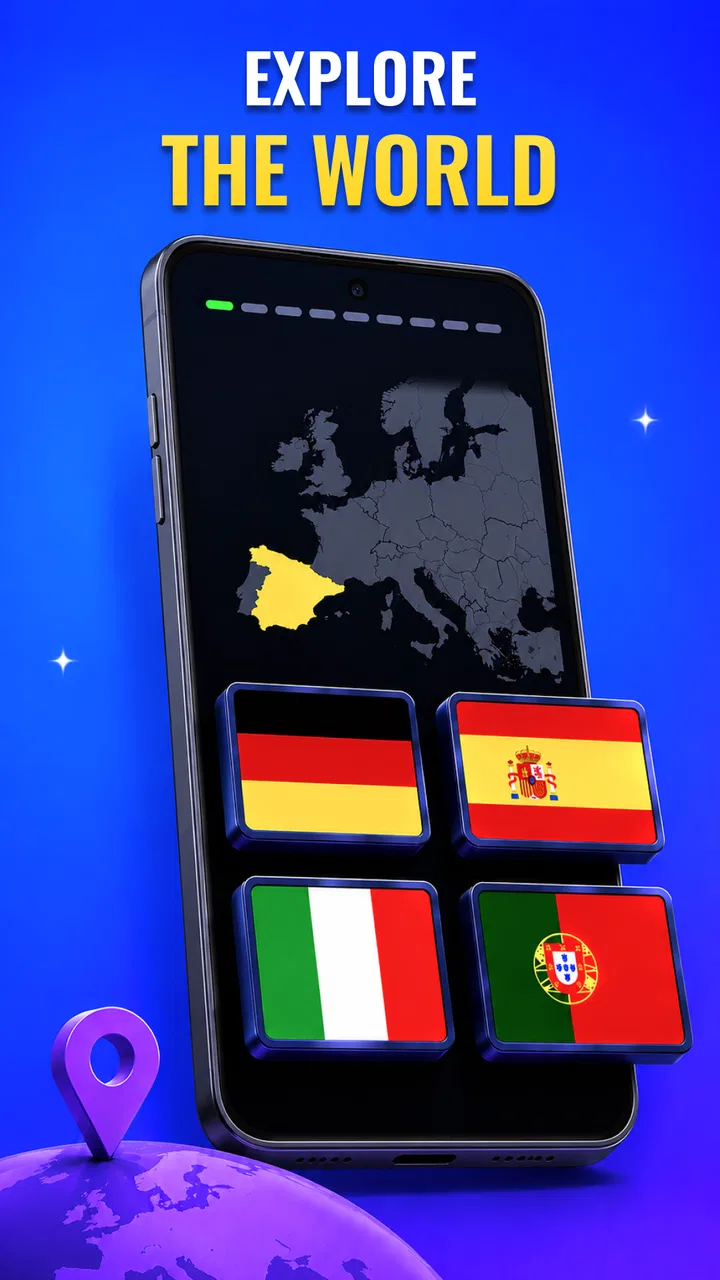
Globo: World Geography Game
- 4.7
- Rating
- 100.00K
- Installs
- Free
- Price

 Analysis by App-foxy
I enjoy trivia games most when they make me curious after I miss an answer, and Globo: Geography Quiz & Trivia fits that kind of session well. It is a free geography game from NaKo Games LLC that turns questions about the world into quick challenges, with the added pressure of competing against other players in live multiplayer battles. I found it easy to understand from the first round, but not so shallow that every question felt obvious.
The basic appeal is simple: you test what you know about countries, places, and the wider world, then use mistakes as prompts to learn. That makes it a better fit for a short break, a family challenge, or a light study session than for someone looking for a deep strategy game. Its average rating of 4.7 from around 3.3 thousand ratings suggests that the central idea is connecting with many players, while more than 100 thousand installs show that it has found a meaningful audience.
How Globo feels to play today
My first impression is that Globo works because it keeps the subject focused. Many trivia apps jump between celebrities, sports, history, and random facts. Here, the geography theme gives each question a clear identity. Even when I already know the answer, I still get the satisfaction of placing it in a larger mental map: a capital, a flag, a landmark, a border, or a detail about a country.
You May Also Like

 Pandora - Music & Podcasts
Pandora’s Music Is Easy to Start, but Harder to Recover
Pandora’s strength is its low-effort path from a seed to a station. Its weak spot is how much confidence it asks you to place in connection, setup, and quiet recovery.

 8 Ball Pool
 Is Built on Rivalries, Rematches, and Routine
A close look at the rivalries, rematches, shared routines, and unanswered safety questions that turn a quick pool match into a persistent mobile community.

 Samsung Music
’s Quiet Strength Is Playing What You Already Own
Its reach comes less from spectacle than from dependable access to a personal library. That simplicity is both the app’s strongest retention engine and its ceiling.

 AccuWeather: Weather Radar
AccuWeather Review: A Quick, Clear Forecast for Everyday Decisions
For everyday plans, the best forecast is the one you can understand quickly. AccuWeather makes rain timing, radar, and local conditions easy to act on, with a few trade-offs.

 Hill Climb Racing
Why Hill Climb Racing Still Turns Crashes Into One More Run
A tiny car, a bumpy hill and one more upgrade: Hill Climb Racing keeps resurfacing because its simple chaos makes every near-miss feel personal.

 AliExpress - Shopping App
AliExpress Makes Global Shopping Feel Personal, but Shoppers Bear the Risk
AliExpress turns a global marketplace into a pocket-sized discovery engine. Its reach is useful, its shopping loop compelling, and its trade-offs easy to miss.
More From Our News Desk
View All News


The live multiplayer angle changes the mood considerably. A solo question can feel like a personal knowledge check, but a timed battle makes hesitation costly. I found that the game rewards quick recognition as much as careful knowledge. Someone who knows a fact but spends too long second-guessing it may perform worse than a player with slightly less knowledge and faster instincts.
That tension is one of the strongest parts of the experience, although it is also where the game may frustrate patient learners. If your goal is to study every answer calmly, a live round is not always ideal. If your goal is to test recall under pressure, the format is much more engaging than scrolling through a static list of geography facts.
The game is rated Everyone, which matches its approachable subject matter and casual presentation. I can see it working for younger players who enjoy quizzes, adults who want to refresh their world knowledge, and families looking for something more educational than a standard arcade distraction. Still, an age rating does not tell you whether the pace suits a particular child; a player who dislikes timed competition may prefer a slower learning tool.
Globo is also free, so trying it does not require a financial commitment. That matters for a trivia game because its value depends heavily on whether the question style and competitive rhythm suit you personally. I would install it for a few short sessions before deciding whether it deserves a regular place on my phone.
The learning value behind the questions
The most useful way to approach Globo is not as a perfect geography course, but as a memory trigger. A wrong answer can expose a gap that I did not know I had. I might recognize a country’s name but confuse its capital, or remember a flag without being able to place the country confidently. Those small surprises are where the game becomes more than a reflex test.
I recommend keeping a mental note of questions that repeatedly catch you. Instead of trying to memorize everything in one sitting, I would group mistakes by theme: capitals, flags, locations, or cultural facts. That makes later review more manageable and turns casual rounds into a personal study routine. The game itself supplies the prompt; the player has to decide whether to treat it as entertainment only or as a lightweight learning aid.
One practical use is a five-minute warm-up before studying geography, traveling, or preparing for a school quiz. I would not rely on it as the only source for formal learning, because trivia questions usually test recognition rather than full understanding. Knowing a capital does not automatically explain a country’s history, geography, or political context. Globo is strongest as a doorway into those subjects, not a replacement for them.
Why live competition changes the experience
Live battles give the app a social pulse that ordinary flashcards lack. The presence of opponents makes familiar questions feel more urgent, and it can motivate me to return after a disappointing round. I often play more attentively when another person’s score is visible than when I am simply answering questions alone.
There is a trade-off, though. Competitive play can make the learning experience feel less forgiving. A player may tap quickly to avoid losing time and then remember the correct answer only after the round ends. That is useful for identifying weak recall, but it can also create the feeling that the game is measuring speed rather than knowledge.
For that reason, I would use the competitive mode differently depending on my mood. When I want excitement, I answer instinctively and accept mistakes. When I want to learn, I slow down mentally between rounds and think about why an answer was unfamiliar. This simple change prevents the multiplayer format from becoming a sequence of wins and losses with no lasting benefit.
Another realistic scenario is playing with a friend while waiting for an appointment or during a relaxed evening at home. Geography gives the conversation somewhere to go: a surprising country fact can lead to a discussion about travel, food, languages, or maps. That makes the app more suitable for shared casual play than a trivia title built around obscure specialist knowledge.
What the current release tells me
The game was released on November 30, 2024, and the current version is 2.1. That places Globo in a relatively early stage of its product life compared with long-established trivia platforms. I see that as both an opportunity and a reason to keep expectations realistic. A newer game can feel focused and fresh, but its long-term depth depends on how consistently the developer expands and refines it.
NaKo Games LLC has chosen a clear identity rather than presenting Globo as an all-purpose quiz collection. That focus is valuable. A geography-only game can build a stronger sense of purpose than one that mixes unrelated subjects, and it gives future improvements an obvious direction. New question variety, better learning feedback, and smoother competitive sessions would all strengthen the same core idea instead of pulling the game into different genres.
The move to version 2.1 indicates that the app has already progressed beyond its initial release, but I would not treat the version number as proof of any particular feature or overhaul. What matters to me is how the current build feels in actual use: whether rounds remain enjoyable, whether the question pool feels varied, and whether multiplayer adds energy rather than friction. Those are the areas I would judge directly rather than assuming that a newer version automatically means a complete transformation.
For existing players, the practical effect of using a current build is that they are experiencing the game as it stands now, not the launch version. That matters in a trivia app because small changes in question presentation, pacing, or reliability can affect the entire rhythm of play. I would still keep an eye on future updates, especially if I became a regular player, because repeat value depends on the game continuing to feel fresh.
How it compares with familiar alternatives
Compared with a standard flashcard app, Globo is more entertaining and less controlled. Flashcards let me choose a topic, repeat a difficult item, and study at my own pace. Globo gives me a more spontaneous test and makes the activity feel like a game. I would choose flashcards for deliberate memorization and Globo when I want learning to happen through quick decisions.
Compared with a broad general-knowledge quiz, Globo offers a narrower but more coherent experience. A general quiz may be better for someone who wants constant subject changes and a wider range of questions. Globo is the better choice for a player who enjoys maps, countries, capitals, and world knowledge enough to stay with one theme for repeated sessions.
It also differs from a traditional map-learning tool. A map app may help me see where a country is and understand its neighbors, while Globo challenges whether I can retrieve that information without visual assistance. The two approaches complement each other: I would use a map to build understanding and the quiz to check whether the knowledge is sticking.
Against a purely offline trivia game, the live multiplayer focus is more exciting but potentially less predictable. A quiet solo quiz is easier to pause and better for a commute or a place with interruptions. Globo suits uninterrupted bursts more naturally, especially when I want the competitive element to matter. If I regularly play in situations where notifications, weak connectivity, or sudden pauses are common, a simpler offline alternative may be more convenient.
Small habits that make the game more useful
My first tip is to separate speed practice from knowledge practice. In a competitive round, answer decisively and accept that some mistakes are caused by hesitation. Afterward, revisit the ideas that surprised you. This prevents the timer from becoming the only thing you improve.
My second tip is to avoid judging your geography ability from a single battle. A question set can expose one narrow weakness, and a fast opponent can make a good player feel worse than they are. I would look for patterns across several sessions instead: do capitals cause trouble, or is it location-based knowledge? That distinction tells me what to study next.
My third tip is to use the game socially without turning every session into a contest. Asking a friend why an answer is correct can make the fact more memorable than simply seeing a result. It also helps younger players explain what they know instead of tapping through questions silently. In my experience, that conversation is where the educational value becomes more durable.
A fourth useful habit is to play when your attention is available. Because live questions reward quick responses, I would not start a battle while multitasking or rushing through a crowded commute. A short, focused session is more satisfying than a distracted one, and it gives the competitive format a fair chance to work as intended.
Where the experience still has limits
The narrow subject focus will not appeal to everyone. If I want trivia about films, music, science, or current events, Globo cannot replace a broad quiz app. Its specialization is its identity, but that also limits its usefulness for players who need variety more than geography practice.
The competitive structure may also be a poor match for people who dislike time pressure. Some learners need space to read an explanation, compare alternatives, and build confidence. A fast battle can reveal what I do not know, but it may not explain the subject deeply enough on its own. I would skip Globo as a primary learning tool if my main requirement were detailed lessons rather than quiz-based reinforcement.
There is also a natural risk of repetition in any focused trivia game. Once a player has seen many questions, the challenge can shift from understanding geography to remembering the game’s answer patterns. That is not necessarily a flaw, but it is something I would watch over time. The long-term experience depends on whether the content continues to feel varied and whether returning players still have reasons to think rather than simply recall.
I would also be cautious about recommending it to someone who wants a completely private, interruption-free study session. The live battle concept is central to the appeal, yet it is not the most flexible format for every setting. For quiet revision, a dedicated geography reference or flashcard system remains more practical. Globo is at its best when I want a lively check of my knowledge, not when I need a carefully structured lesson plan.
What I would watch as the game develops
Because version 2.1 is the current release, I would pay attention to how NaKo Games LLC handles the game’s next stage. The most important question is not simply whether more content arrives, but whether new content improves the quality of repeat play. A growing question pool should continue to test understanding rather than rely on obscure details that feel random.
I would also watch the balance between speed and accuracy. The best version of a live geography quiz should reward quick thinking without making careful players feel that knowledge matters less than tapping instantly. Small improvements to how questions are presented or how results help players learn could make a significant difference, even without changing the basic format.
Another area worth observing is the relationship between competition and education. Globo already has a strong reason to be replayed because battles create tension. Its lasting value will be greater if each round also leaves players with something they can remember. Clearer learning moments, useful context, or better ways to recognize recurring weaknesses would help bridge the gap between a fun quiz and a genuinely helpful geography companion.
Finally, I would judge future updates by consistency. A trivia game earns trust when its questions feel carefully chosen, its pacing remains comfortable, and the central experience stays easy to enter. I would rather see thoughtful refinement of the geography format than a sudden expansion into unrelated subjects that weakens the app’s identity.
My recommendation
I recommend Globo: Geography Quiz & Trivia to anyone who likes learning through quick challenges and wants geography to feel more active than reading a list of facts. It is especially suitable for short sessions, friendly competition, and players who enjoy discovering gaps in their world knowledge. The free price makes experimentation easy, and the Everyone rating keeps its audience broad.
I would not choose it as my only geography resource, and I would not recommend it first to someone who dislikes timers, live competition, or repeated quiz formats. For those users, a map tool, a structured course, or a slower flashcard app may deliver more control. For me, however, Globo succeeds as a focused trivia game with a useful educational edge.
The strongest way to use it is to play for enjoyment, notice the questions that expose weak spots, and then follow those curiosities beyond the round. That approach gives the game more value than chasing a score alone. With its geography focus, multiplayer energy, and current version 2.1, Globo is most convincing as a quick world-knowledge workout rather than a complete course. I would keep it installed for those moments when I want to compete, learn a surprising fact, and see how much of the world I can actually recall under pressure.
FAQs for Globo: World Geography Game
01What is Globo: Geography Quiz & Trivia?
Globo: Geography Quiz & Trivia is an engaging educational app designed to test and enhance your geographical knowledge. Users can participate in various quizzes and trivia challenges, covering topics like capitals, flags, and landmarks. The app offers a fun way to learn about the world with increasing levels of difficulty.
02Is Globo suitable for all age groups?
Yes, Globo is suitable for users of all ages. The app is designed to be accessible and enjoyable for both children and adults. It offers different levels of difficulty, allowing users to start easy and gradually tackle more challenging questions, making it ideal for family learning and interaction.
03Does Globo require an internet connection?
Globo does not require a constant internet connection to play. While you need to be online for initial downloads and updates, the quizzes can be played offline. This makes it convenient for users who want to enjoy the app without worrying about data usage or connectivity issues.
04Are there any in-app purchases in Globo?
Yes, Globo includes optional in-app purchases. These purchases may offer additional quiz packs, hints, or ad-free experiences. While the basic version is free and fully functional, these purchases can enhance the user experience for those interested in exploring more content or enjoying the app without advertisements.
05How does Globo help improve geographical knowledge?
Globo enhances geographical knowledge through interactive quizzes and trivia that cover a wide range of topics, such as countries, capitals, flags, and landmarks. The app uses a fun, gamified approach to learning, encouraging users to engage with the content regularly, track their progress, and challenge themselves with harder questions.
Pros
- Engaging quizzes with diverse topics.
- User-friendly interface for easy navigation.
- Offline mode available for travel learning.
- Regular updates with new questions.
- Compete with friends for leaderboard glory.
Cons
- Limited free content; in-app purchases needed.
- Occasional glitches during gameplay.
- Ads can be intrusive at times.
- Lacks detailed explanations for answers.
- Requires internet for some features.

Globo: World Geography Game
Gallery